

WebOne Web Builder
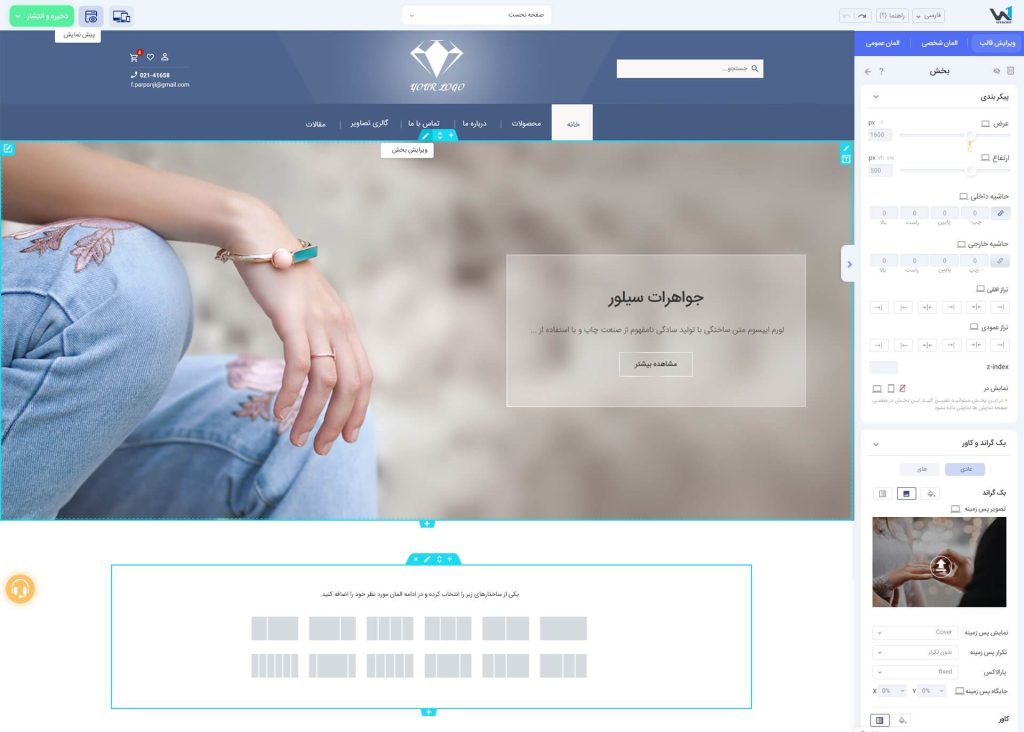
This website builder was developed by Web One.
Project duration: 9 months
Design team members:
- Behnam Shabrandi, Product Manager
- Fatemeh Parpanji, UI/UX Designer
- Niloufar Arefnia, Scrum Master and Sales Manager
- Moein Mortazavi, Computer Engineer (Consultant for coding limitations)
Introduction
Web One is a web design company that primarily focused on offering pre-built websites. Over time, the company’s sales declined, and through phone interviews with customers, we discovered that they were not interested in pre-built websites. They felt that these websites were not unique enough and that similar designs might be used by dozens of others. However, most customers also did not want to pay the high costs of custom website design.
In response to this need, we decided to design a panel that would allow customers to make small changes to pre-built websites, giving them a sense of uniqueness.
To achieve this, and to understand user needs more clearly, we decided to conduct phone interviews with individuals searching for web design companies online. Initially, we identified the characteristics of people who met the interview criteria, meaning they closely resembled our future customers, and prepared the interview questions. For this, we first had to define the goals of designing the new project.
Goals of the Website Builder Design:
Increase sales and attract new customers: By developing a user-friendly website builder, we can attract customers who are interested in custom websites but cannot afford the high cost. This tool will allow us to tap into the market of customers looking for semi-custom solutions at an affordable price.
Enhance user experience and increase customer satisfaction: Providing a simple and flexible tool for users will improve the user experience, driving more customers to use your websites. This positive experience can lead to higher satisfaction and customer retention, ultimately increasing sales.
Increase conversion rates and reduce customer churn: Many customers who would have gone to competitors due to the high cost of custom designs can stay within your customer base using this website builder. This will reduce the churn rate of current customers and increase conversion rates.
Diversify services and products offered: With a website builder, you can provide a broader range of services rather than relying solely on selling pre-built websites. This variety (from pre-built to simple customizations) allows customers more options, leading to increased sales of new services.
Increase scalability and expand market reach: The website builder can help you access larger and newer markets. Markets that may have been lost in the past due to high prices or complex design processes are now accessible with the website builder. Additionally, international market expansion becomes feasible.
Reduce support and development costs: By offering an automated and user-friendly website builder, the number of support requests and technical issues from users will decrease. This will lead to reduced costs for human resources and support.
Increase project delivery speed and reduce development time: Using a website builder can significantly reduce the time required for website development. This faster delivery allows your company to complete more projects in less time, ultimately increasing revenue.
My Role:
In this project, I was responsible for user experience analysis. From the beginning of the project, defining interview questions and identifying the characteristics of interviewees, to analyzing and creating personas, defining challenges, managing brainstorming sessions, and finding solutions for the identified challenges, I played a key role. I also designed the user interface.
Research Method
During the development of this application, we utilized a Design Thinking approach to understand our customers’ needs. In the initial phase, we prepared interview questions, and our sales team conducted interviews with customers. A major challenge identified was the long wait times for appointments. To address this issue, we decided to interview doctors to understand their needs and explore ways to reduce appointment durations without compromising the quality of care.
Target Audience for Interviews:
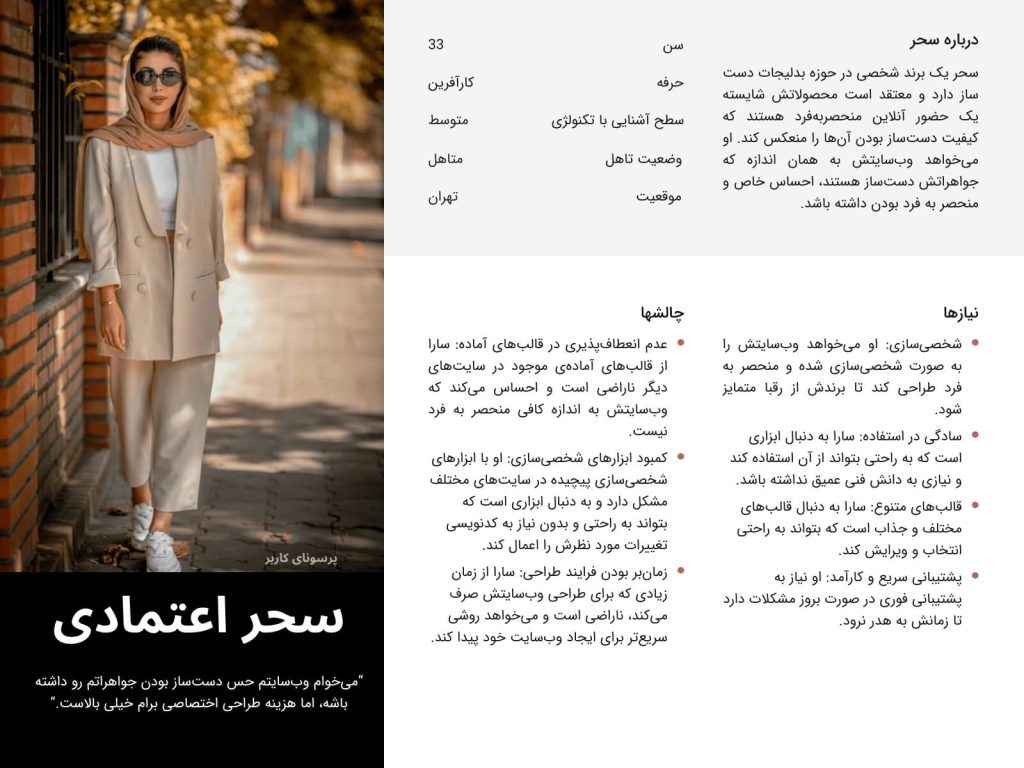
- Small business owners: Individuals looking for semi-custom website designs but lack the budget for fully customized websites.
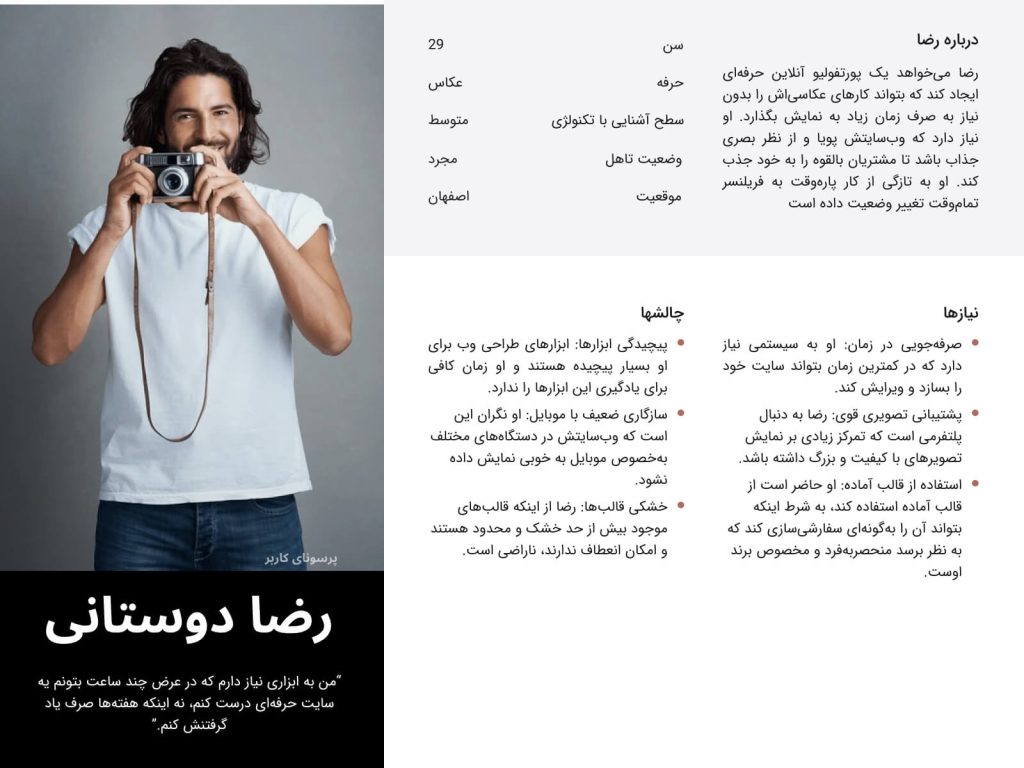
- Freelancers and artists: People who need an online portfolio but don’t want to spend too much time on website design.
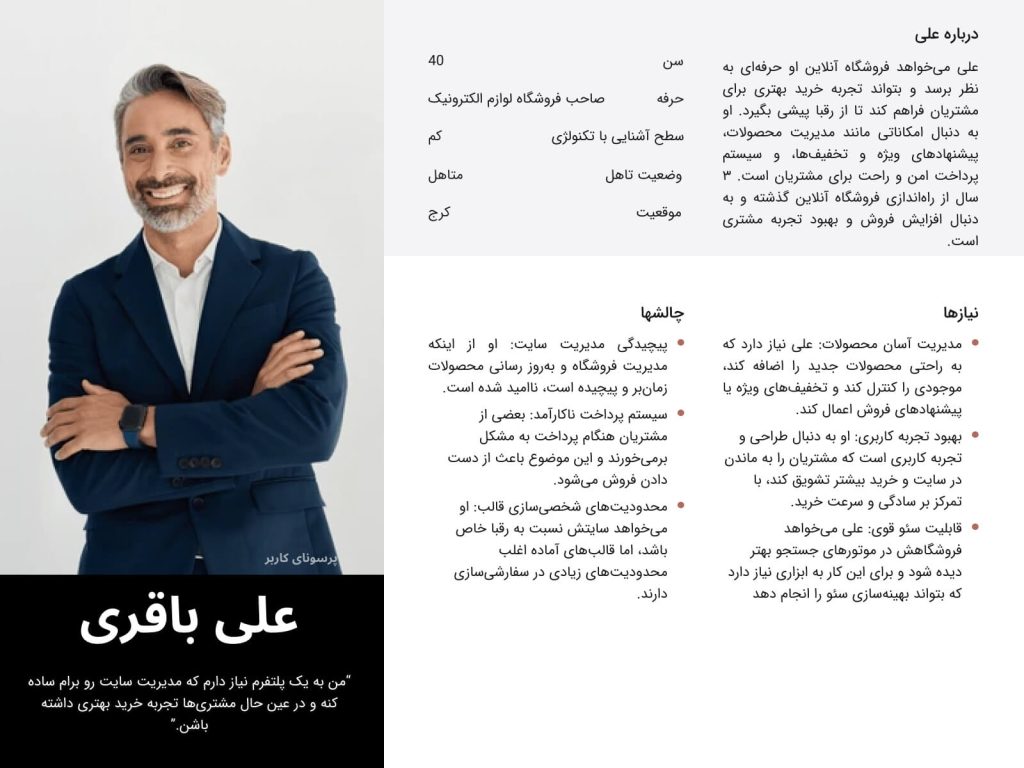
- Small online retailers: Businesses looking for an affordable solution to develop their online store.
- Doctors and medical clinics: Those seeking systems to improve the patient visit experience and reduce wait times.
Persona
After conducting interviews with five potential customer, we developed three empathy maps
Pain Points
After conducting interviews and preparing user personas, we identified several key pain points that highlight the main challenges customers face when using website builders. Recognizing these issues helped us gain a better understanding of user needs and identify current weaknesses. These pain points have been transformed into problem statements to guide the project and indicate which areas need to be addressed.
Pain Points:
Lack of uniqueness in ready-made websites: Customers feel that ready-made websites are not unique enough and may be used by several others.
Insufficient budget for custom designs: Customers do not have enough budget for custom websites but are dissatisfied with the generic look of ready-made sites.
Complexity of current website builder platforms: Current website builders are very complex for users with less experience in website design.
Long wait times for custom website design: Customers are unhappy with the long wait times for custom website designs.
Limited customization options: Customers are dissatisfied with the limited customization options in ready-made websites.
Poor user experience: The user experience of current website builders is not engaging enough to encourage continued use.
Technical limitations: Customers often cannot implement all their requirements on the website due to the technical limitations of website builders.
Inability to address specific user needs: Ready-made websites do not meet the specific needs of customers.
Difficulty in creating online stores: Customers face challenges in creating online stores due to shortcomings in website builders.
Lack of adequate technical support: Customers struggle with insufficient technical support from website builders to resolve issues easily.

Ideation Phase
In order to find solutions for each of the challenges, we first conducted a competitor analysis to examine how our competitors have addressed the challenges we face. After that, using the ideas derived from the competitor analysis and the research conducted on the limitations of implementing their solutions, we hold brainstorming sessions. In these sessions, we generate several “How Might We” questions for each challenge, and then each team member is responsible for answering these questions. We then score the responses and identify the best answer for each solution.
Competitor Analysis
In this competitive analysis, we focus on popular website builders such as Wix, Elementor, Webzi, and other well-known site builders that enable users to create custom websites without needing technical knowledge. To aid in the decision-making for designing the panel, we can evaluate these tools from various aspects such as ease of use, customization features, pricing, and pros/cons.
Competitor Analysis Model
For comparison, we use this competitive analysis model that includes five key factors:
- Ease of Use
- Customization Features
- Pricing Model
- Support & Services
- Design Library & Templates
Analysis of Website Builders
Wix
Ease of Use: Wix features a very simple interface with drag-and-drop functionality, making it one of the most widely used website-building tools. Even users without technical knowledge can easily modify pages and add their content.
Customization Features: Users can choose from thousands of ready-made templates, but customization is limited to changes in colors, fonts, and layouts. More advanced changes (such as manual coding) can be complex.
Pricing Model: Wix uses various pricing models, including free plans and paid plans with additional features. Free options are limited to Wix domains and display advertisements.
Support & Services: Offers 24/7 support via email, phone, and chat, but the level of service depends on the user’s subscription. Higher support levels are provided for professional users.
Design Library & Templates: Wix has one of the largest design template libraries. These templates are categorized based on different businesses, but users cannot easily create advanced combinations of templates.
Strengths: Very simple user interface. Wide variety of templates.
Weaknesses: Advanced customization is limited and complex. Professional users may be dissatisfied with limited coding flexibility.
Elementor
Ease of Use: Elementor is recognized as a plugin for WordPress that offers advanced page design capabilities. Although it is user-friendly for beginners, it requires a basic understanding of WordPress and content management.
Customization Features: Elementor offers high customization power. Users can change any section of the website using drag-and-drop, and professional users can also make CSS and JavaScript changes.
Pricing Model: Elementor has a free version that offers basic features, but more advanced capabilities require purchasing the paid version. Pricing is adjusted based on the user’s needs regarding the number of sites and various features.
Support & Services: Support in the free version is limited and mostly provided through documentation and forums. Pro users have access to quicker support.
Design Library & Templates: Elementor has a large number of ready-made templates and design blocks that users can easily customize. It also features a vast library of design widgets.
Strengths: High customization capabilities. Suitable for professional designers and developers.
Weaknesses: Initial complexity for beginner users. Limited support in the free version.
Webzi
Ease of Use: Webzi is an Iranian website builder aimed at providing a simple and practical environment for Persian-speaking users. Its user interface is very similar to international tools and is designed for users with minimal knowledge.
Customization Features: Webzi users can easily change templates and customize some page elements. However, compared to Elementor, there are fewer advanced options for code or advanced styles.
Pricing Model: Webzi offers various plans tailored to user needs, ranging from free sites to professional sites with more features.
Support & Services: Webzi provides 24/7 Persian support through chat and phone, making it appealing for Iranian users.
Design Library & Templates: Webzi offers ready-made templates designed for various businesses. Its design library is not as extensive as Wix or Elementor, but it suffices for local users.
Strengths: Suitable for Persian-speaking users. Simple and comprehensible user interface.
Weaknesses: Advanced customization is limited. Fewer templates and features compared to competitors.
Sazito
Ease of Use: Sazito, as one of the Iranian website builders, strives to provide a simple environment for Persian-speaking users. This builder is more suitable for small to medium-sized online stores.
Customization Features: Similar to Webzi, Sazito has limited customization options and focuses more on store capabilities. Users can apply some appearance changes, but advanced settings are restricted.
Pricing Model: Sazito offers various free and paid plans that are mostly tailored to users’ store needs. Professional plans provide more features for online selling and product management.
Support & Services: Persian and quick support via phone and chat is one of Sazito’s strengths. Users can easily communicate with the support team.
Design Library & Templates: The number of templates on Sazito is limited and primarily focused on stores, but these templates are well optimized for Iranian businesses.
Strengths: Suitable for online stores. Excellent Persian support.
Weaknesses: Limited features for non-store websites. Weak advanced customization.
Final Analysis and Recommendations:
In examining these competitors, it becomes clear that each of these tools has its own unique advantages and disadvantages:
- Wix: A suitable option for businesses seeking simplicity and diverse templates, but it may not be the best choice for advanced customization.
- Elementor: The best option for professional users who want complete control over website design. If your company wants to offer advanced features to users, drawing inspiration from Elementor could be a good idea.
- Webzi and Sazito: Excellent for the Persian-speaking market, but they lack advanced features like those seen in Elementor. If you are focusing on Iranian users, attention to the Persian language and simple user interface is crucial.

Brainstorming
During the ideation phase, we focused on generating innovative solutions to address the key challenges identified in our research. By employing creative brainstorming techniques and creating “How Might We” questions for each Problem statement, we explored various approaches to enhance the efficiency of Web builder. below you can see the process for one of the problem statment
Problem Statement 1:
Challenge: Lack of a Unique Feel in Ready-Made Websites
1.AMP Up the Good
How Might We Question:
How might we enhance the positive aspects of ready-made website designs to increase the feeling of uniqueness for users?
How might we make ready-made templates feel more personalized without increasing costs?
How might we allow users to customize specific elements of their websites while still maintaining the structure of the template?
How might we provide users with design flexibility without overwhelming them with too many options?
- Solution 1: Introduce appealing and user-friendly design tools that allow users to easily change design elements.
- Solution 2: Organize design competitions for users to share and showcase their creations.
- Solution 3: Provide online tutorials and resources to enhance user design skills and creativity.
2. Explore the Opposite Method
How Might We Question: How might we increase the feeling of a lack of uniqueness in ready-made websites?
- Solution 1: Design templates that are completely identical and visually indistinguishable.
- Solution 2: Remove customization options from the platform and offer only one or two templates to users.
- Solution 3: Create a registration process that allows users to build their site only by selecting from limited options.
3. Change the Status Quo
How Might We Question: How might we change the current state of ready-made website design to create a sense of uniqueness for users?
- Solution 1: Implement an AI system that suggests unique designs based on user preferences.
- Solution 2: Launch a platform where users can share their previous designs and gain feedback from others.
- Solution 3: Provide customizable design templates that allow users to create unique designs by changing several features.
4. Break the Point of View into Pieces
How Might We Question: How might we break down different user perspectives into smaller parts to enhance the sense of uniqueness in website designs?
- Solution 1: Conduct a detailed analysis of user needs and tastes, offering various design options accordingly.
- Solution 2: Create a selection process from a set of design templates, each containing specific customizations.
- Solution 3: Hold consultation sessions with users to identify their specific requests and needs in design.
Solutions
In the solution phase, we consolidated the most promising ideas and translated them into practical, user-centered features. Each solution was carefully designed to directly address the challenges identified earlier, ensuring that they fit within the real-world workflow of healthcare professionals. From optimizing electronic prescriptions to streamlining communication between doctors and nurses, every aspect was fine-tuned to improve efficiency, reduce errors, and enhance the patient experience. The solutions are as follows:
- Introducing a design panel that allows for small changes on pre-made templates:
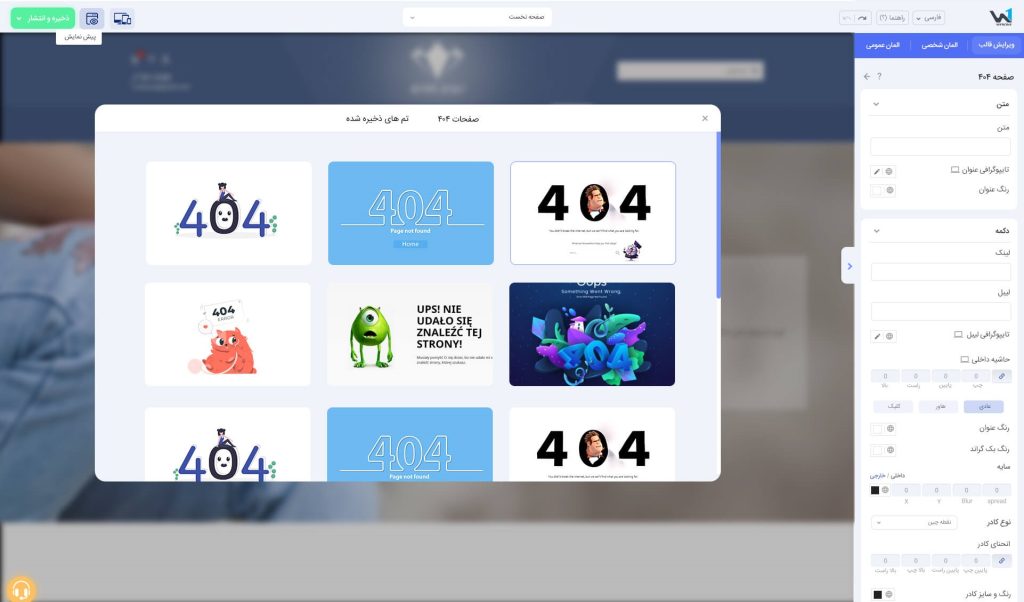
- This panel enables users to make subtle adjustments in design, such as changing colors, fonts, and images, allowing them to achieve a personalized feel without needing to design from scratch.
- Creating an advanced settings system for selecting and combining different sections:
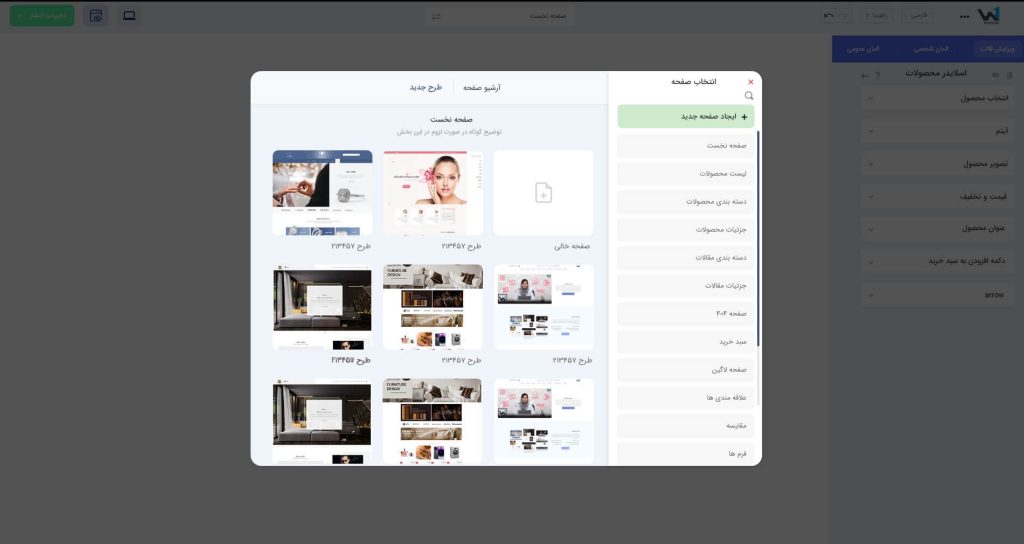
- This system allows users to select each section of their website (like header, footer, menu, banner, and product section) from several available options. Users can mix and match these sections from different templates, giving them the sense of designing something unique, without requiring specialized knowledge or starting from scratch. This feature provides greater flexibility in customizing the website while maintaining the overall structure and integrity of the template.
- Developing an advanced settings system for customization:
- This system allows users to customize and configure specific elements of their website (such as menus, footers, and headers) without impacting the overall structure of the template.
- Providing step-by-step tutorials and inspirational templates:
- By offering educational resources and templates that users can draw inspiration from, we enhance the sense of ownership in design and boost creativity.
- Enabling the sharing of user-designed templates and layouts:
- Users can share their designs with others, fostering a sense of community and connection.
- Continuous user feedback and analysis for template improvement:
- We collect user feedback to improve templates and customization options, ensuring they feel their opinions are reflected in the design process.