Troodon: A Comprehensive Platform for Selecting the Best AI Models
Introduction of Hi-Fi Prototyping of the App
Introduction
Troodon is a new application developed by a team of students from Sharif University of Technology and funded by a company based in Dubai. The goal of this app is to bring together a variety of artificial intelligence models in one platform. At this stage, we are focused on market research and identifying the needs of users. Our aim is to understand the user experiences and challenges faced when working with various AI tools. The app will be available in both Persian and English to cater to a global audience
My Role
In this project, I was responsible for conducting user experience analysis. I also designed the landing page and the core app. Throughout the process, I conducted interviews with target users, performed needs assessments, carried out a comprehensive competitive analysis, and identified and resolved user challenges.
Research Method
For our research, we employed the Design Thinking methodology. This approach helps us creatively and empathetically explore the real needs and problems users face. In the Empathy stage, we conducted user interviews to better understand their challenges and frustrations with AI tools.
Target Audience of Interview
for interview we have to selected some p
1.Individuals aged 18 to 35
2.Users who interact with AI tools at least once a week
3.Open to all genders professions and educational backgrounds.
Pain Points
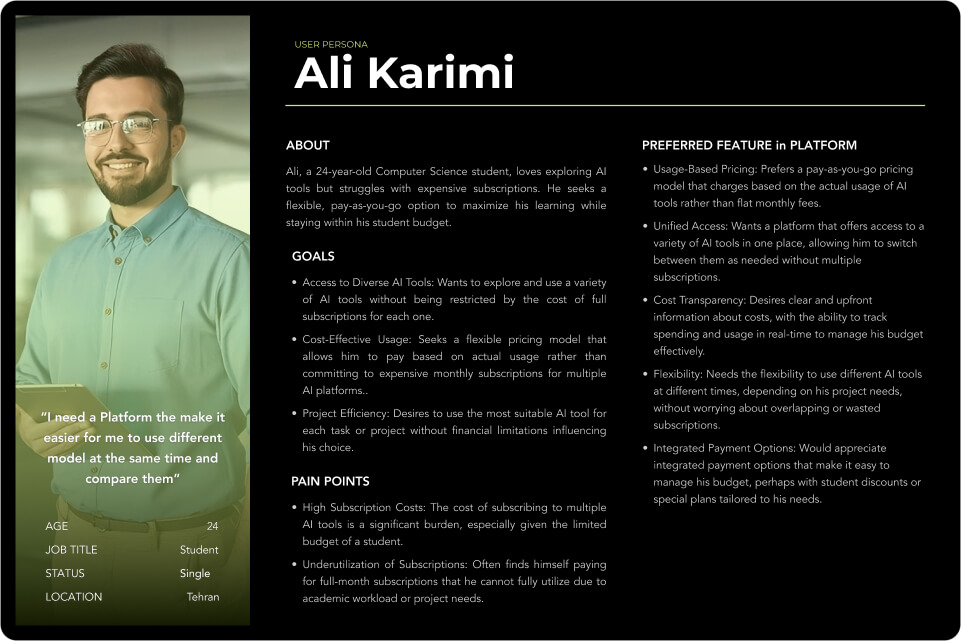
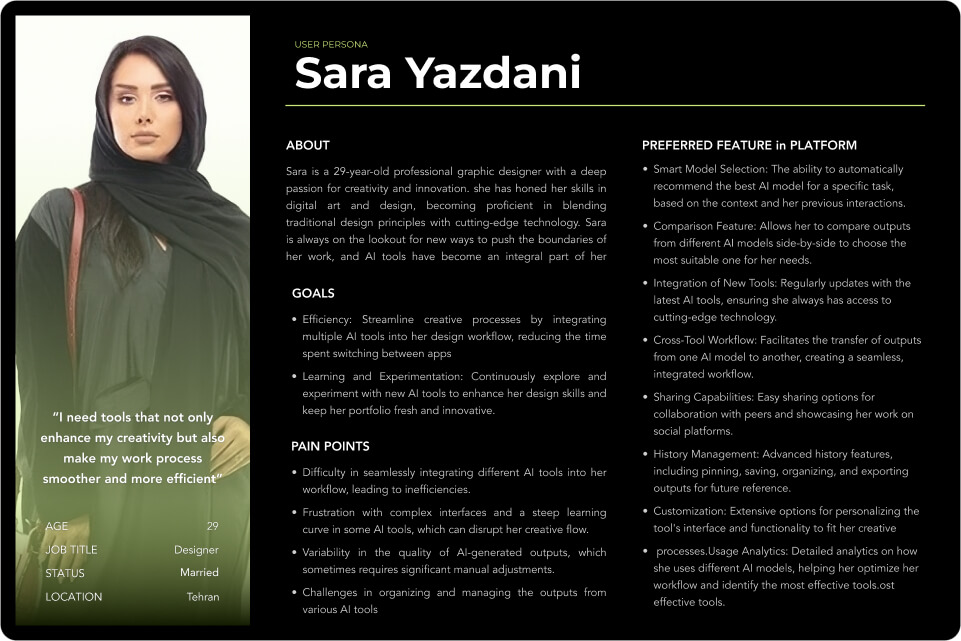
after interview we get this pain points and then for designing the app that meet needs of user we define user persona to be able to understand our users
AI Tools Don’t Fully Meet Needs:
- Users find that many AI tools, especially those for image generation, don’t fully understand their specific requests or intentions.
Overwhelming Variety of AI Models:
- The large number of AI tools available leads to confusion, making it hard for users to choose the right model for their tasks.
Lack of Comparative Information:
- Users struggle with comparing different AI models, as there isn’t enough accessible information to help them make informed choices between them.
Limited Awareness of Specialized AI Tools:
- Students, especially in coding, are unaware of less popular AI models that might be more suited to specific tasks, such as code generation. Instead, they default to more generalized tools like ChatGPT.
High Cost of Subscription Plans:
- Monthly subscriptions for multiple AI models are financially prohibitive for students, preventing them from testing or accessing different models, which limits their exploration and experimentation.
Lack of Usability for Testing Multiple Models:
- Economic concerns prevent users from trying multiple AI models, especially when each model requires its own subscription, making it inefficient to compare options.
User Persona
User Journey Map
We analyze the entire user experience through a User Journey Map to identify Problem statements and challenges along the way.
Problem Statements
Users need a way to easily compare and choose the right AI model for their specific tasks because the overwhelming variety of AI tools makes it difficult to identify the best option, which results in inefficient usage.
Students who frequently use AI tools are frustrated by the high cost of subscription plans, which limits their ability to explore and test multiple AI models, resulting in restricted access to more advanced or specialized tools.
Many AI tools, especially in image generation, fail to fully understand users’ specific needs and requests, leading to unsatisfactory results, particularly in creative tasks like design
Users are unaware of specialized AI tools that could be more suited to their specific tasks, such as coding, which causes them to rely on generalized models like ChatGPT, reducing productivity and efficiency
Define Phase
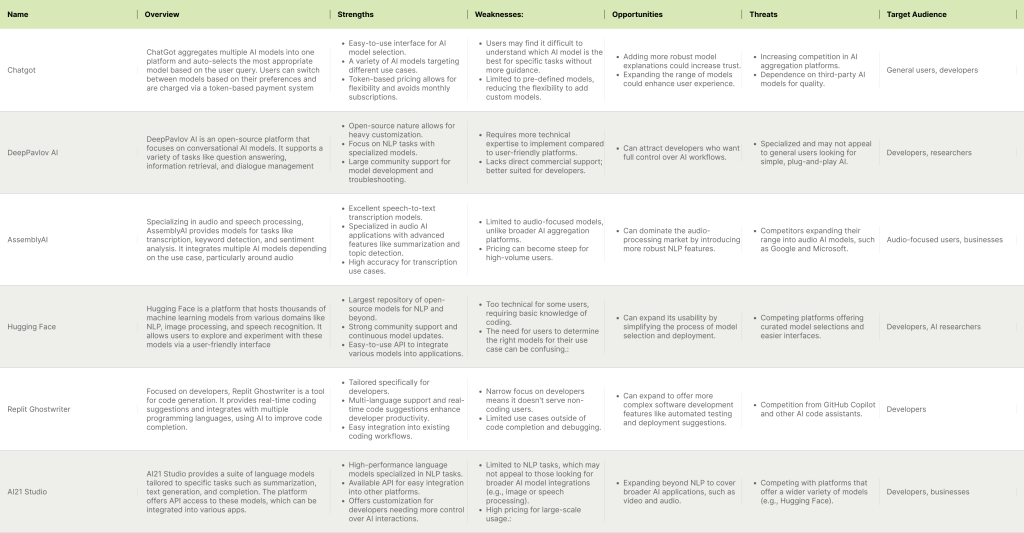
In the second phase of Design Thinking, Define, we conducted a competitive audit and brainstorming session.
Competitive Audit
The primary goal of this competitive audit is to understand how other platforms, similar to ours, handle the variety of AI models they offer. In particular, we aim to identify strategies that these platforms use to overcome challenges in AI-generated outputs, such as models failing to understand user intent—especially in image generation tasks where the AI
doesn’t accurately capture the user’s vision.
After analyzing competitive, brainstorming and and “How Might We” questions we define some solutions for each problem statements.
Result of Competitive Audit
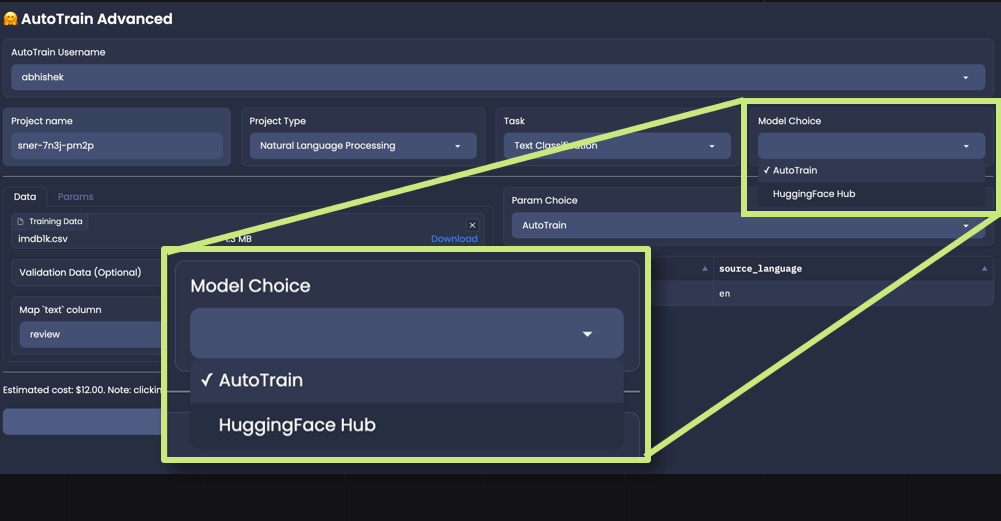
One competitor we analyzed was Hugging Face, a platform similar to ours, offering various language models. Hugging Face has a feature where it suggests the best AI model for a given task. This could address the issue faced by users like Sara, whose AI models fail to meet their expectations. However, it was unclear how Hugging Face determines the best model, and we couldn’t access their data. After further research, we found that Stanford University has developed a benchmark that identifies the best language model for each topic, which validated our idea of automatic model selection.
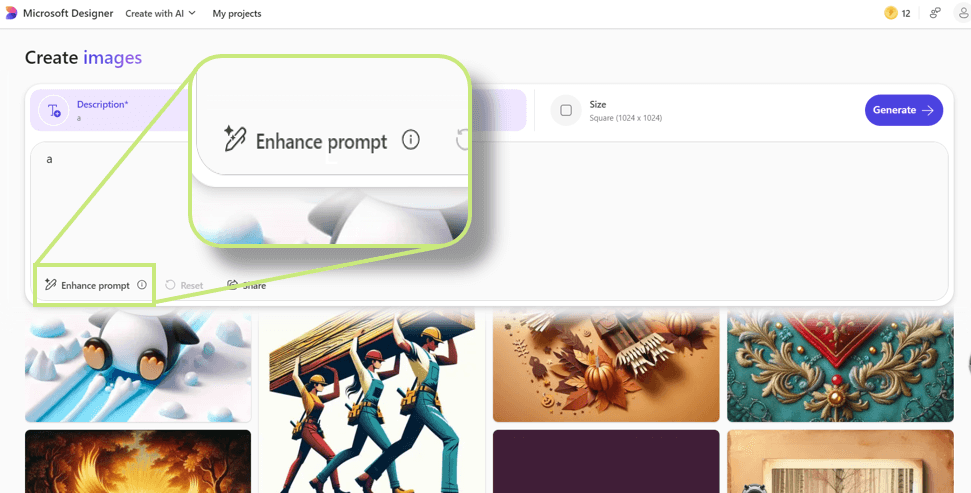
Another competitor was Microsoft Designer, an image generation app. While not a comprehensive AI platform, it helps users improve their prompts. However, it was unclear how keyword suggestions were chosen to optimize the prompt. This led us to propose an AI assistant that could refine user prompts to better communicate with image generation models.
(How Might We Questions) Brainstorming session
In pursuit of more solutions, we held brainstorming sessions using the How Might We technique. In these sessions, we followed four methods for generating “How Might We” questions, and each team member contributed as many solutions as possible.
How Might We… (using AMP up the good)
(Focus on enhancing the positive aspects)
How might we make it easier for users to discover the right AI models through improved visibility and guidance?
- Provide AI model recommendations based on user preferences and past successful projects.
- Implement a visual dashboard that highlights the most commonly used AI models for specific tasks.
- Introduce a smart search feature that filters models based on performance metrics relevant to the user’s task.
How Might We… (using Explore the Opposite)
(Flip the problem to understand it from a completely different angle)
How might we make the overwhelming variety of AI models a strength rather than a limitation?
- Design a “Random AI model” generator that suggests a new model each time, encouraging exploration and discovery.
- Create a mode where users can experiment with multiple AI models simultaneously and compare the outcomes.
- Use AI to automatically match and suggest a few contrasting models, showing differences and letting users choose based on comparative performance.
How Might We… (using Change the Status Quo)
(Question the default process and innovate with a fresh approach)
How might we transform the current way users select AI models into a more intuitive and time-efficient process?
- Replace complex AI selection lists with a simple flowchart or decision tree that guides users step by step.
- Implement a model selection wizard that asks for user requirements and outputs only the top 3 models.
- Allow AI to automate the comparison process and directly suggest the optimal model based on the user’s task.
How Might We… (using Break the Point of View into Pieces)
(Dissect the problem into smaller aspects and address each separately)
How might we make model comparison easier by addressing the different challenges in the decision-making process?
- Address choice overload by organizing AI models into clear categories, such as “image generation” or “text analysis.”
- Provide users with more transparent model performance data, including pros, cons, and success rates for specific tasks.
- Build an intuitive AI comparison tool that automatically displays differences in model architecture and features.
- Create a model “comparison board” where users can add up to three models and directly compare their performance on test data.
Solution
Problem Statement 1:
Users need a way to easily compare and choose the right AI model for their specific tasks because the overwhelming variety of AI tools makes it difficult to identify the best option, resulting in inefficient usage.
Solution:
- We will leverage Stanford University’s AI model benchmark to recommend the best language model based on the user’s query. First, the app will identify the query’s topic and then suggest the most appropriate language model.
- Another solution is pre-defining model categories for specific tasks. For example, if a user wants to code, they can be directed to a section where the best language model for coding is already suggested.
- Additionally, we will implement a feature that allows users to switch between language models directly within the same page for each query, enabling easy side-by-side comparisons of different models.
Problem Statement 2:
Students who frequently use AI tools are frustrated by the high cost of subscription plans, which limits their ability to explore and test multiple AI models, resulting in restricted access to more advanced or specialized tools.
Solution:
We will introduce a token-based payment system. Instead of subscribing to an entire AI model on a monthly basis, users can purchase tokens to use only the specific features or models they need, making access more affordable and flexible. This system will allow students and other users to test and explore a variety of models without committing to expensive subscription plans.
Problem Statement 3:
Many AI tools, especially in image generation, fail to fully understand users’ specific needs and requests, leading to unsatisfactory results, particularly in creative tasks like design.
Solution:
- We will incorporate an AI assistant as a mediator. This assistant, powered by a language model like ChatGPT, will act as a translator between the user and the image generation AI (e.g., MidJourney). Users will provide the assistant with their requests, and the assistant will generate the optimal prompt for the image generator, ensuring that the output is closer to the user’s expectations.
- Additionally, we will provide prompt enhancement guides. For instance, we’ll offer documentation or visual guides explaining how adding certain keywords (e.g., “close-up” or “wide-angle”) to the prompt can improve the image results. These guides will help users refine their inputs based on real examples and best practices.
Problem Statement 4:
Users are unaware of specialized AI tools that could be more suited to their specific tasks, such as coding, which causes them to rely on generalized models like ChatGPT, reducing productivity and efficiency.
Solution:
- We will keep our platform continuously updated with the latest language models, ensuring that users have access to a wide variety of AI tools that are specialized for different tasks. By increasing the variety of models and introducing new ones, we will help users discover more tailored solutions for their specific needs beyond general models like ChatGPT.
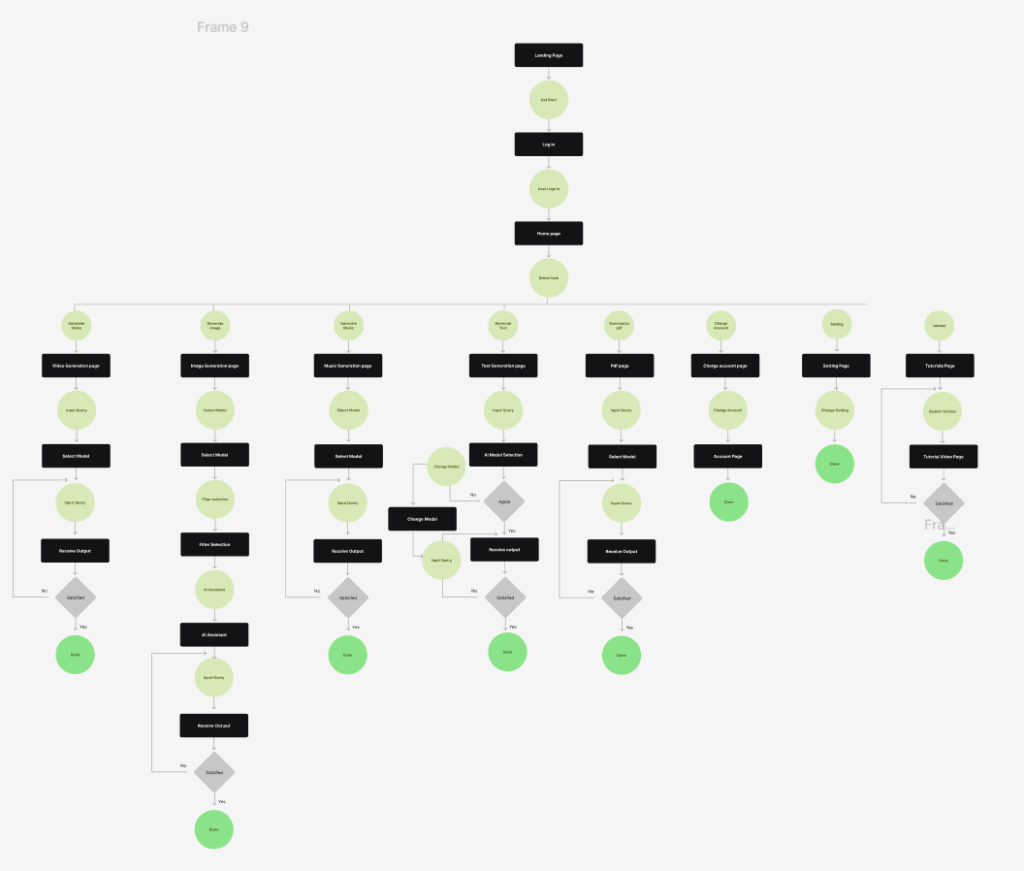
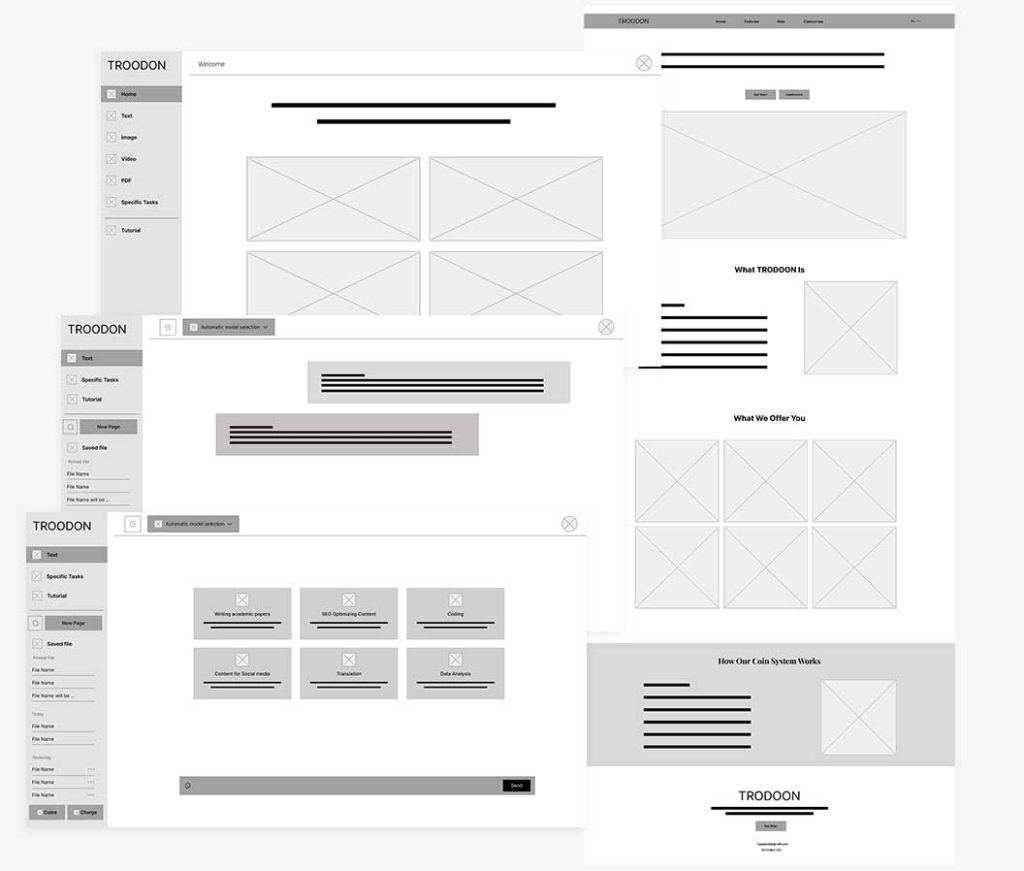
User Flow and Wireframe
To design this application that meets all user needs, we first mapped out the user flow, outlining the journey from start to finish. This helped us structure the information architecture for all sections. Following that, we created a wireframe to simulate the site and app’s functionality, allowing us to test and validate the design before moving to the final development stages.